
Singapore Hosting vs Bangladesh Hosting: How to Choose a Server Region
Server location influences network paths, but the best hosting region depends on where your users live and what your website does. Businesses in Bangladesh often compare local data centers with Singapore because both can be viable for different audiences.
Quick answer: Choose Singapore or Bangladesh hosting by measuring real visitor and application performance. Verify stack compatibility, CDN behavior, backups, and support quality before moving a production website.
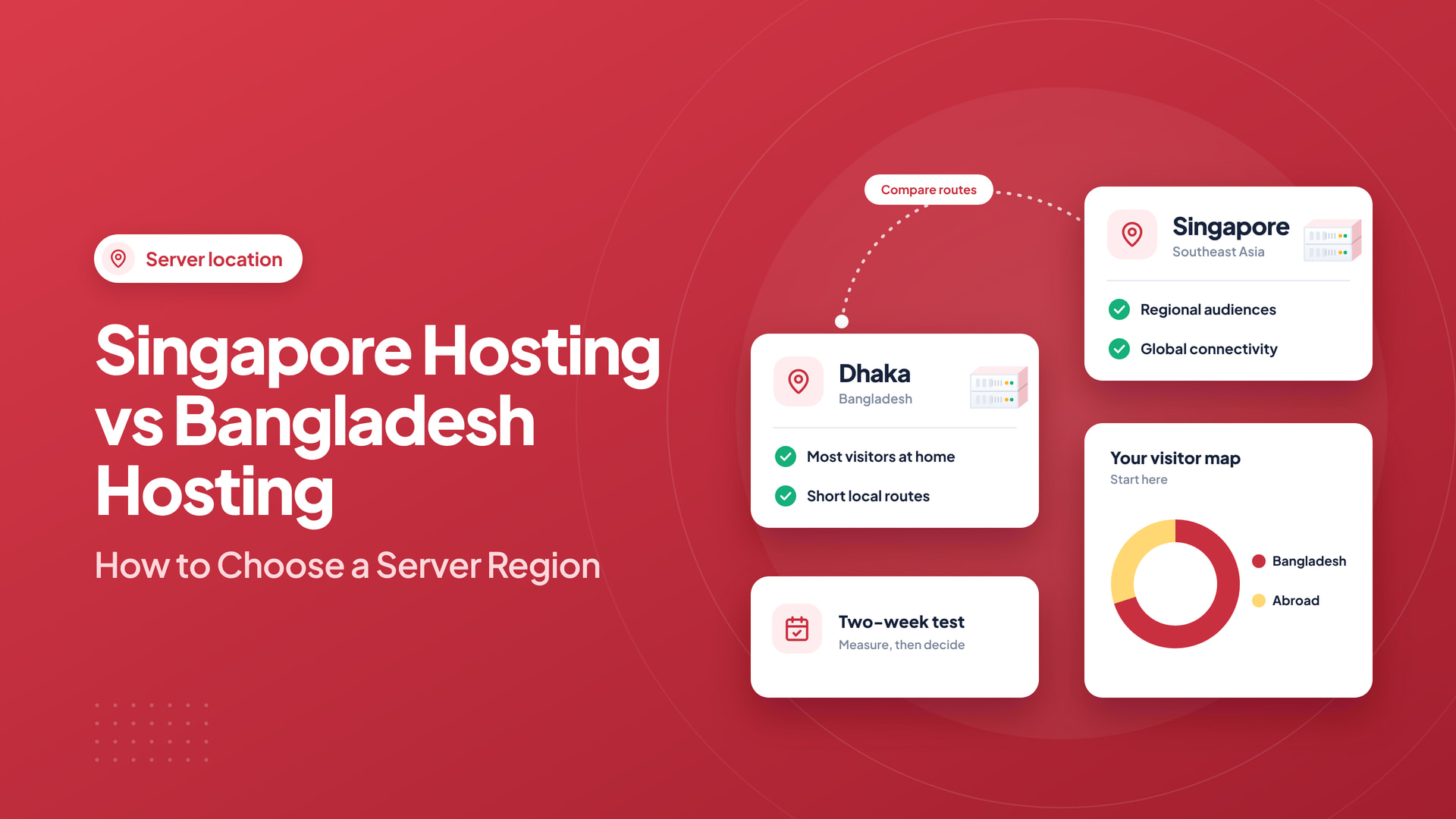
Begin with the visitor map
Check analytics to identify the countries where most visitors are located. A Bangladesh-only news portal may benefit from domestic routing. A software product reaching customers across South and Southeast Asia might find Singapore convenient to evaluate.
Neither location guarantees the best result for every internet service provider. International connectivity, peering arrangements, congestion, and content delivery networks all influence performance.
Measure meaningful performance
Test uncached page responses from several networks and locations. Compare latency, time to first byte, throughput, and error rates. Repeat tests at different times instead of relying on one attractive screenshot.
For an ecommerce site, test the actual checkout and account pages. For a media site, examine image delivery. For an API, inspect response-time percentiles and failures during simultaneous requests.
Think about your application stack
A static site, WordPress blog, PHP application, and Node.js service may require different environments. Verify the runtime, deployment access, database options, process limits, and software restrictions before ordering. Some shared hosting packages are not suitable for persistent background services.
Check the backup model
Confirm backup frequency, retention, and whether a restore is self-service. A weekly backup may be appropriate for a largely static site, while a frequently updated system might need a shorter recovery point. Keep a separate backup whenever data is valuable.
Compare actual regional offers
Intelwebhost publishes Singapore hosting plans with cPanel, NVMe storage, SSL, and stated backup features. Compare the chosen tier with Bangladesh-based alternatives and check the current resource limits. Avoid treating advertised uptime percentages as proof that a service has never experienced an outage.
When a CDN can change the answer
Static files can often be served from edge locations closer to visitors. That means the origin server does not need to be geographically close to every user. Dynamic requests and database operations still depend on the origin and application design.
Map users and application dependencies before choosing a region
The server closest to a visitor is not necessarily the best origin for every request. Traffic may travel through a CDN, an external API, a payment gateway, or a regional database before a page is complete. For a Bangladesh-first content site, a Bangladesh origin may be attractive. For a Southeast Asian SaaS serving multiple countries, a Singapore region may offer convenient regional connectivity. Actual routing, reliability, and application behavior should decide the result.
Plot visitor locations using privacy-respecting analytics. Identify which pages are mostly static and which require dynamic server processing. A content site with strong caching may be less sensitive to origin location than a real-time dashboard that performs frequent authenticated requests.
Test performance in the way users actually work
Compare a cached article page, an uncached search result, an authentication action, and a representative database-backed request. Use the same application build, data snapshot, PHP or Node version, cache policy, and test procedure in both regions. Measure more than one moment: time to first byte, user-visible loading, error rate, and slowest common responses. Record whether CDN routing changes the origin reached by the browser.
| Scenario | What to test |
|---|---|
| Bangladesh-focused online magazine | Local mobile loading and international access |
| Regional SaaS with API clients | Authenticated requests and database round trips |
| WooCommerce store | Checkout, gateway callbacks, and email notifications |
| International portfolio | CDN effectiveness and global browsing experience |
Consider the application stack before buying
Shared hosting features vary by location. Confirm support for the required PHP version, databases, cron tasks, SSH access, and any Node.js or Python deployment requirement. If the site needs persistent Node workers or custom system packages, verify support explicitly; some shared hosting environments intentionally limit such processes. A VPS may be more suitable for specialized runtimes.
Also inspect backup frequency and retention. “Daily backups” without a reliable restoration process may be less useful than a clearly documented recovery policy. Decide how much data the business can afford to lose and whether backups are stored in a separate failure domain.
Email, DNS, and regulation are separate decisions
Hosting a website in Singapore does not require moving email there. You can use a separate mail provider and retain the domain with its current registrar. Moving origin servers also does not necessarily change the legal requirements for handling customer information; review your own obligations and any applicable contracts. Avoid assuming a specific data residency policy without professional advice.
For deployments with global visitors, use a CDN carefully. Cache public assets and pages as appropriate but bypass personalized content, checkout, and private APIs. If performance differs unexpectedly by region, investigate DNS, peering, and CDN routing before replacing the server.
A two-week evaluation plan
During the first few days, establish identical staging deployments. In the next phase, collect comparable measurements from Bangladeshi mobile networks, fixed-line providers, and one or two international locations. Test backup restores and support channels in both environments. Before production cutover, select the region whose measured performance, feature compatibility, cost, and operational support best fit the business—not simply the region with the lowest ping in one screenshot.
Regional selection checklist
- Identify the primary audience and dynamic application paths.
- Test actual visitor networks, not only synthetic cloud locations.
- Check runtimes, backup policies, and management features.
- Verify email and DNS remain intact during migration.
- Consider CDN behavior for static and dynamic content.
- Reassess after launch as the visitor mix changes.
Make a decision using a short test
Deploy a representative staging website, test it from your important customer networks, and monitor it for a realistic period. Evaluate support and total renewal cost alongside the measurements.
Choose the hosting region that produces dependable outcomes for the people using your site. Proximity is useful evidence, but real application measurements should make the final decision.
Frequently asked questions
Is Singapore hosting better for all Bangladeshi websites?
No. Domestic and international routing, visitor distribution, application workload, and CDN strategy determine which region performs better.
Does changing server region require changing the domain registrar?
No. Registrar, DNS provider, website hosting, and email hosting can remain separate services.
Can I host Node.js on every Singapore shared hosting package?
Not necessarily. Confirm supported runtimes, persistent processes, package policies, and database options on the exact plan.
