
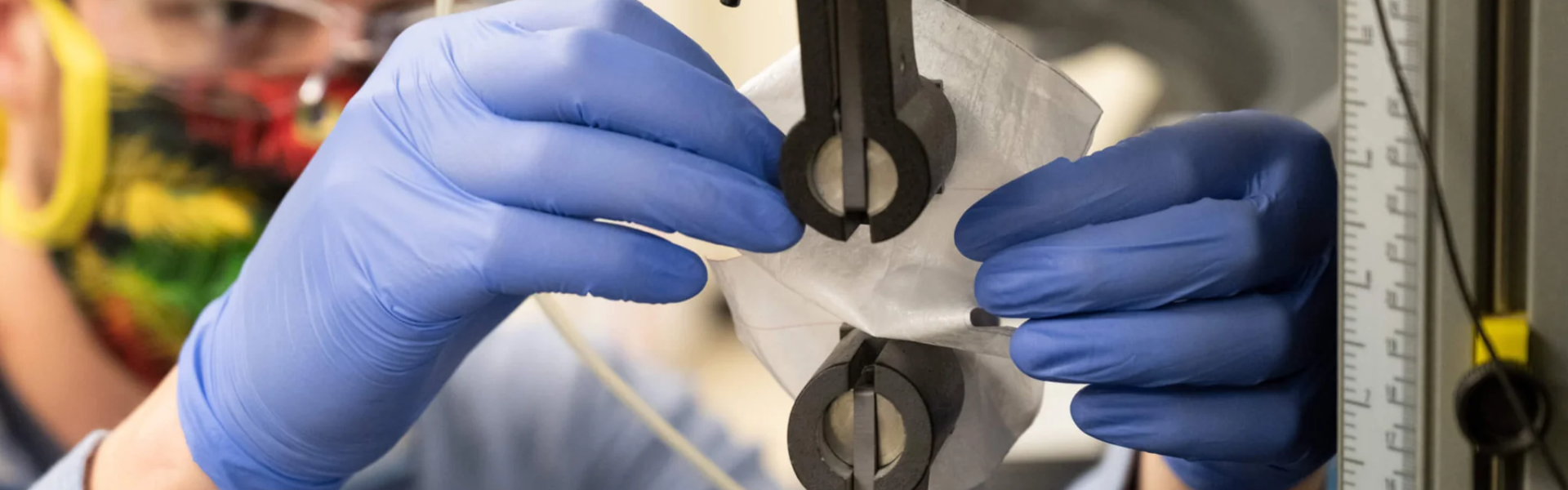

The art of making fabric is ancient, but the science of verifying its performance has never been more advanced. In a world where technical textiles are used in everything from heart stents to aerospace components, the need for precise textile measuring machines is paramount. A modern textile testing instrument is no longer a simple ruler or weight; it is a complex opto-electronic system designed to quantify the physical and chemical limits of a material. As the industry faces new challenges in 2026—ranging from the rise of smart wearables to the demand for recycled fibers—the role of accurate textile measurement has become the defining factor for market success.
The Evolution of Non-Contact Measurement
One of the most significant hurdles in traditional textile measurement was the physical interference of the measuring tool itself. When measuring the thickness or expansion of a soft, compressible fabric, the pressure of a mechanical probe can change the result. Modern textile measuring machines have overcome this through the use of laser displacement technology.
A leading example is found in the HydroBurst bursting strength tester. Traditional machines used a mechanical rod to measure the height of the fabric as it expanded under pressure. This rod could snag the fibers or apply unwanted resistance. The latest textile testing instrument models from ChiuVention use Panasonic laser sensors to track the fabric’s movement without ever touching it. This ensures that the textile measurement is a true reflection of the material’s structural integrity. This non-contact approach is particularly vital for delicate materials like silk or specialized non-wovens used in the hygiene and medical industries, where even the slightest deformation can lead to a “false fail.”
Multidimensional Stress and Material Analysis
Fabric in the real world is rarely pulled in a straight line. It is twisted, stretched, rubbed, and pressured from all directions. Therefore, a comprehensive textile testing instrument must be able to simulate these multidimensional stresses. The modern textile measuring machines found in a high-end lab include Martindale abrasion testers that move in complex Lissajous patterns and bursting testers that apply uniform hydraulic or pneumatic pressure across a surface.
The data captured by these instruments allows for a “360-degree” material analysis. For instance, a quality manager can use textile measurement data to determine the exact point where a fabric transitions from “elastic” (returning to its original shape) to “plastic” (permanently deformed). This is essential for the sportswear industry, where “shape retention” is a key selling point. By utilizing advanced textile measuring machines, manufacturers can guarantee that a pair of compression leggings will provide the same level of support after 100 washes as they did on day one. This level of scientific certainty is what separates premium brands from the competition.
Digital Management and Laboratory Efficiency
The true power of a modern textile testing instrument is unlocked when it is connected to a digital ecosystem. In 2026, “isolated testing” is considered an obsolete practice. Through the SmarTexLab platform, textile measuring machines are now part of an integrated network that automates data collection and analysis. This shift has a massive impact on laboratory efficiency.
In a traditional lab, a technician might spend 40% of their time on administrative tasks—writing down results, calculating averages, and typing up reports. With a smart textile testing instrument, these tasks are handled by the machine’s internal processor and the cloud. Once the textile measurement is complete, the results are instantly compared against a database of global standards. If the sample fails to meet the target, an alert is sent directly to the production manager’s smartphone. This “instant feedback loop” allows for much faster troubleshooting, reducing the “Long Testing Cycle” that has plagued the industry for decades.
Future-Proofing Through IoT and AI
As we look toward the future, the integration of Artificial Intelligence (AI) into textile measuring machines is the next frontier. AI-driven vision systems are already being used to automatically grade “pilling” and “snagging” tests, replacing the subjective human eye with a standardized digital algorithm. This ensures that a “Grade 4” result in a lab in China is exactly the same as a “Grade 4” in a lab in the USA.
Furthermore, IoT-enabled textile measuring machines allow for remote diagnostics and Over-the-Air (OTA) software updates. This means that when a new international testing standard is released, the textile testing instrument can be updated instantly via the cloud, without the need for a technician to visit the site. For manufacturers, this means their equipment is “future-proofed” against changing regulations. By investing in smart textile measurement technology today, factories are ensuring they remain relevant and compliant in the high-tech, highly regulated textile market of tomorrow.